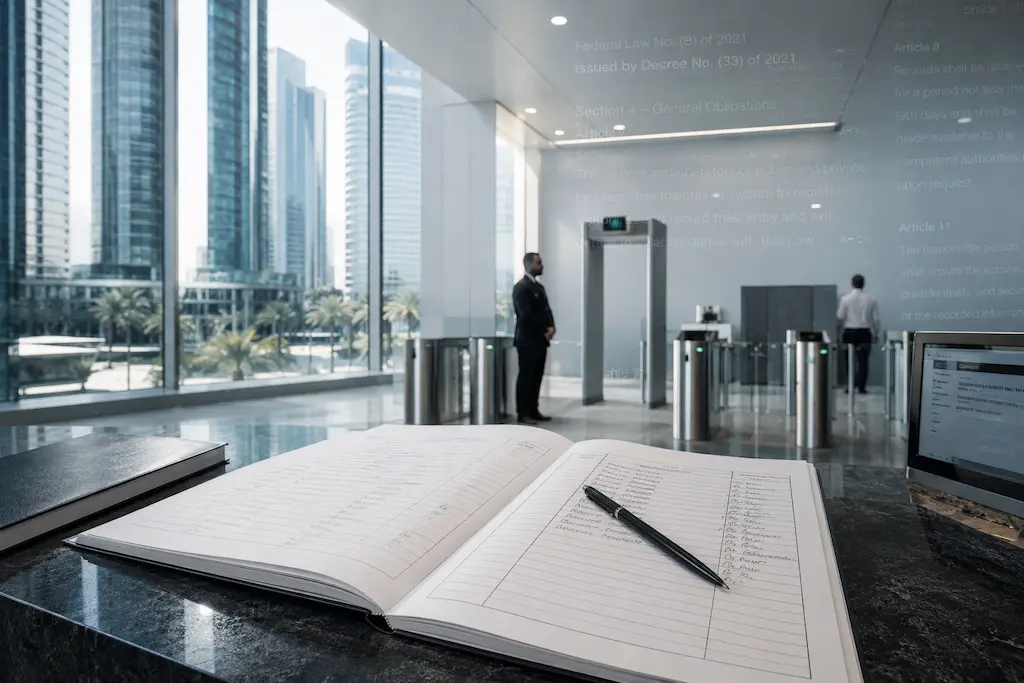
The Legal Necessity of Secure Visitor Management Software in the UAE
Every building that welcomes visitors in the UAE is making a legal commitment, whether its management team realises it or not. The UAE's regulatory landscape has shifted decisively in recent years, and organisations that treat visitor tracking as an administrative afterthought are quietly accumulating compliance risk with every unverified guest and unsigned logbook.
The stakes are real. UAE Federal Decree-Law No. 45 of 2021 introduced a comprehensive personal data protection framework that fundamentally changed how organisations must handle personal information, including the names, ID numbers, and contact details collected at reception desks every day. This is not limited to digital businesses or technology companies. Any organisation processing visitor data is directly in scope.
What makes this particularly urgent for building operators and facility managers is the layered nature of UAE compliance obligations. Free zone jurisdictions like the DIFC and ADGM carry their own distinct data protection regulations, meaning visitor records collected at your front desk may fall under multiple legal frameworks simultaneously. A paper logbook visible to the next person in line is not just an operational inconvenience. It is a potential violation.
Compliance is not optional infrastructure. It is the foundation that protects both the people who enter your building and the organisation responsible for them.
SIRA and Dubai Police: Direct Mandates for Visitor Management
Two specific regulatory bodies make visitor oversight non-negotiable in Dubai: the Security Industry Regulatory Agency (SIRA) and Dubai Police. Together they set enforceable standards that go well beyond general property law, and facilities that fall short face real consequences.
SIRA, operating under the Dubai Police General Headquarters, governs all aspects of security operations in the emirate. Its licensing framework requires that any building with a formal security function, including access control, maintains documented visitor records that can be audited at any time. This is not a recommendation. It is a condition of operating with approved security personnel on-site. If your building employs licensed security guards, SIRA expects a corresponding system for logging and verifying every person those guards admit.
Dubai Police reinforces this expectation through its Smart Secure City initiative, which aligns physical security practices with digital traceability. Facilities in commercial zones, residential towers, and mixed-use developments are increasingly expected to demonstrate that they can reconstruct a visitor timeline when requested. A paper logbook rarely meets that standard reliably or quickly.
Data integrity is also central to the conversation. UAE Federal Decree-Law No. 45 of 2021 on Personal Data Protection governs how visitor information is collected, stored, and shared. Failure to handle visitor data lawfully can expose building management to regulatory action entirely separate from security violations.
A compliant visitor record is not just a log. It is evidence. In regulatory terms, the absence of evidence is its own liability.
Dubai Strata Law and Management Obligations
Another layer of obligation governs how residential and mixed-use developments handle visitor access: Dubai's strata and jointly owned property framework. Under Jointly Owned Property Law (Law No. 6 of 2019) and its associated regulations, owners associations and facility management companies carry direct responsibility for the safety and security of common areas, including lobbies, parking structures, shared corridors, and amenity spaces. These are not advisory guidelines. They define accountability.
What this means in practice is that building managers cannot treat visitor oversight as a discretionary task. A documented failure to monitor and record who enters a property can expose the owners association to civil liability if an incident occurs involving an unlogged visitor. If you control the space, you are responsible for what happens in it.
Many buildings still rely on paper logbooks or informal sign-in sheets despite the well-documented risks those systems carry. Outdated manual processes leave gaps in verification, make audit trails difficult to reconstruct, and create compliance vulnerabilities that regulators increasingly scrutinise. Any effective policy must define who enters, when, under what authorisation, and how that data is stored and reviewed.
For residential towers and commercial developments operating under strata structures, the obligation also extends to third-party contractors and service vendors. Every technician, delivery driver, and maintenance worker accessing the property represents a potential gap in the security perimeter if not properly logged and verified.
Fire Safety, Civil Liability, and the PDPL
Beyond security mandates and strata obligations, building managers in the UAE face a third overlapping layer of compliance that touches fire safety codes, civil liability exposure, and data privacy law simultaneously.
UAE Civil Defence fire safety regulations require that occupant loads in commercial and mixed-use buildings are monitored and controlled. When a visitor enters unlogged, that person becomes an invisible occupant. In an emergency, mustering and evacuation accountability depend directly on knowing who is inside at any given moment. An incomplete visitor log is not just an administrative gap. It can translate into civil liability if harm occurs and records cannot demonstrate due diligence.
Civil liability exposure is growing. UAE tort principles place a duty of care on property operators toward anyone lawfully present on their premises. A visitor injured due to an unrecorded access event, or a security breach enabled by weak check-in processes, can trigger claims that are difficult to defend without timestamped entry data. Legal teams typically look first at visitor logs during any post-incident review. No record often means no defence.
The data protection dimension adds further urgency. The UAE Personal Data Protection Law (Federal Decree-Law No. 45 of 2021) applies to any organisation that collects, stores, or processes personal data, and visitor registration qualifies. Organisations must collect only what is necessary, store data securely, and enable individuals to request deletion. Visitor data collected for security purposes must be handled with the same rigour as employee records. Facilities using compliant digital check-in tools are far better positioned to demonstrate lawful processing.
Robust visitor management is the thread connecting all three obligations, fire safety, civil liability, and data privacy, into a single defensible system.
Sector-Specific Mandates and Free Zone Requirements
The compliance picture described above applies broadly across the UAE, but certain sectors and free zones layer on additional requirements that building managers cannot afford to overlook.
Free zones operate under their own regulatory frameworks. The Dubai International Financial Centre (DIFC) and Abu Dhabi Global Market (ADGM) each maintain independent data protection regimes that go beyond the federal PDPL. For any building located within these zones, consent mechanisms, retention limits, and access controls may need to be stricter than what a mainland facility would require.
Healthcare facilities and educational campuses face a parallel challenge. Visitor logs in these environments can intersect with sensitive personal data including patient adjacency records, parent identification, and contractor access to protected areas. A lapse in visitor data handling carries reputational and legal risk that compounds quickly. The UAE Information Assurance Regulation sets minimum standards for how organisations process and store personal information in digital systems, including gate management platforms.
Hospitality and retail environments present a different configuration. High visitor volumes make manual verification not just inefficient but functionally unreliable. Vendor and contractor access, a daily reality in commercial buildings, must be tracked and auditable to satisfy both insurance and compliance requirements.
A practical starting point is to evaluate whether your current system can generate sector-specific audit trails on demand. Many facilities find that digital check-in technology with MRZ scanning addresses both speed and data accuracy requirements simultaneously.
What This Means For Your Building
The legal landscape governing visitor management in the UAE is neither simple nor static. Compliance is not a single checkbox. It is a layered obligation spanning federal security mandates, strata and owners association requirements, civil liability exposure, PDPL data protection duties, and sector-specific free zone regulations. Buildings that treat visitor access as an administrative afterthought are carrying significant legal and financial risk every day.
The UAE's Personal Data Protection Law is maturing. Enforcement postures are firming up. Regulators across DIFC, ADGM, and mainland authorities are raising expectations simultaneously. A visitor management approach designed for one regulatory environment may leave a building exposed in another, a concern that is particularly acute for organisations operating across GCC free zones where overlapping data protection frameworks apply at the same reception desk.
Documented, auditable, purpose-limited data collection is no longer optional best practice. It is the legal baseline. Manual logbooks, unstructured spreadsheets, and informal sign-in processes cannot meet that baseline reliably.
For building managers ready to move from reactive to proactive compliance, the practical next steps are straightforward:
Audit your current visitor data flow, what is collected, where it is stored, and how long it is retained. Map your obligations against your specific zone, sector, and building type. Evaluate whether your existing tools produce the audit trails, consent records, and access logs that regulators and courts can actually rely on.
The legal case has been made. The question is whether your building's visitor management approach can answer it.